
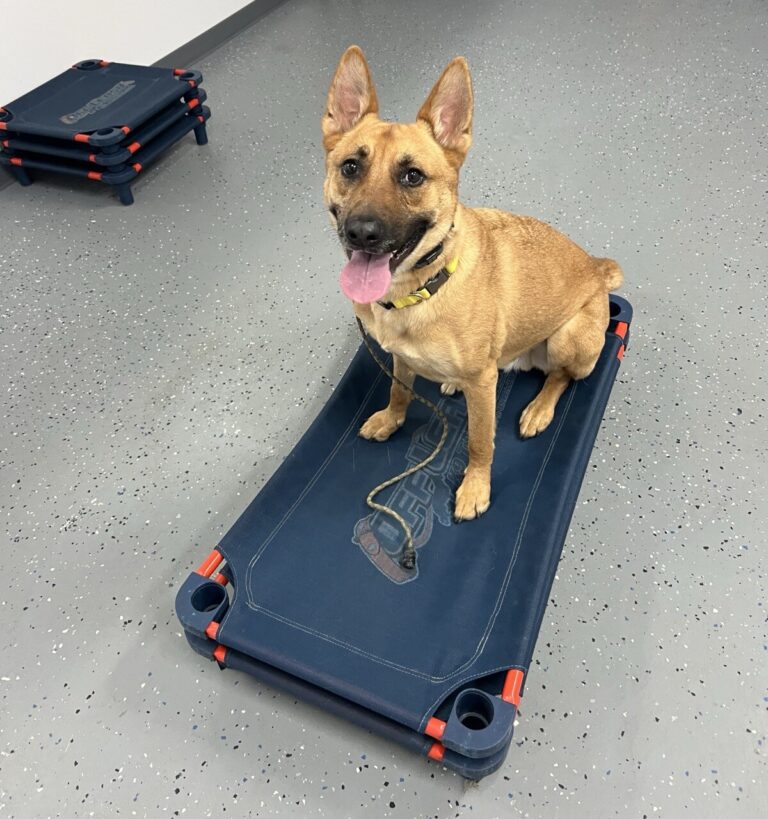

The crate is not a punishment. It is your puppy’s bedroom.
If you just brought a puppy home, you have probably already had the 2 a.m. moment: the crying from the crate, you lying awake wondering whether you are being cruel, and the strong urge to just bring the puppy into bed with you. Maybe you have heard that crates are mean. Maybe you bought one and your puppy treats it like a jail cell.
I’m Jennifer Cattonar, owner and head trainer at Off Leash K9 Training, Jersey Shore. My own house holds three dogs, a cat and a turtle, and the part of my job I love most is our puppy board and train programs. Crate training is one of the first things we work on with every puppy that comes to us, because a puppy who is relaxed in a crate is easier to house train, safer when you are not watching, and calmer in the car, at the vet and at the groomer for the rest of their life. Done slowly, most puppies come to love their crate. Here is how to get there.
Pick the right crate and put it in the right place
Size matters. Your puppy should be able to stand up, turn around and lie down stretched out. Much more room than that and many puppies will use one end as a bathroom. If you buy a crate sized for the adult dog, use the divider panel to shrink it now and move it back as your puppy grows.
Wire or plastic both work. Wire crates are airy and let your puppy see you. Plastic travel crates feel more den-like. Some puppies settle better with a light blanket over a wire crate. Watch that your puppy does not pull the blanket in and chew it.
Location is half the battle. Put the crate where your family actually lives, like the kitchen or living room, during the day. At night, especially for the first few weeks, have it next to your bed. A puppy who can hear and smell you settles much faster than one parked alone in a laundry room.
Keep it simple inside. A washable mat or towel and one safe chew is plenty. Skip stuffed toys and anything your puppy could shred and swallow.
Step 1: Make the crate the best place in the house
For the first couple of days, the door stays open and the crate is just a place where good things happen. Toss a few pieces of kibble or a treat inside and let your puppy go in and get them. Feed meals in the crate, starting near the door and moving the bowl further back as your puppy gets comfortable. Hide a treat in there now and then for your puppy to discover on their own.
Do not push or carry your puppy in at this stage. You want your puppy choosing to walk in. If you use a marker word like “yes” or a clicker, mark the moment all four paws go inside and then reward. That one habit will make the next steps much faster.
Step 2: Close the door for seconds, then minutes
Once your puppy is happily walking in for food, start closing the door while they eat. Open it again before they finish. Over a few days, leave it closed a little longer after the meal, while you sit right next to the crate.
Then give the behavior a name. Say “crate” or “kennel” as your puppy walks in, reward them inside, and close the door for a short stretch while you stay in the room. Build in small steps: 30 seconds, one minute, three minutes, five. Then step out of sight for a moment and come back before your puppy gets upset. The goal is to open the door while your puppy is still quiet, so quiet is what gets them out.
A frozen, stuffed chew toy is your best friend here. It gives your puppy something calm to do and connects the crate with a long, satisfying chew.
The first nights
Night is where most families give up, so plan ahead:
- Tire your puppy out, calmly. A play session and a potty break before bed, then a quiet wind-down.
- Crate right beside your bed. You can put your fingers by the door if your puppy fusses. That is often enough.
- Expect a night-time potty trip. Young puppies usually cannot hold it all night. If your puppy wakes and whines, carry them out, let them go, and put them straight back with no play and no fuss. Our guide to potty training a puppy covers the full schedule.
- Stay boring. Lights low, voice low, back to bed. Night trips are business, not party time.
How long can a puppy stay in a crate?
A common rule of thumb is that a puppy can hold their bladder for roughly one hour per month of age during the day, plus one. So a two month old puppy needs a break about every two to three hours while you are awake. Every puppy is different, and the rule is a starting point, not a promise.
During the day, build a rhythm: out to potty, a short play or training session, back out to potty, then crate for a nap. Young puppies need a lot of sleep, and many of the problems families call us about, from biting to zoomies to barking, ease off once a puppy is getting proper naps in the crate. If you work long days, plan for a family member, neighbor or dog walker to give your puppy a midday break.
What to do when your puppy whines in the crate
Some whining in the first week is normal. What you do next decides whether it fades or grows.
- Could it be a potty need? If it has been a while, take your puppy out on leash, quietly, then straight back in.
- If it is protest, wait for a pause. Letting your puppy out mid-cry teaches that crying opens the door. Wait for even a few seconds of quiet, then open it.
- Go back a step. If your puppy panics every time, you moved too fast. Shorten the time and stay closer for a few days.
- Do not use the crate for time-outs in anger. The crate should always be a safe, calm place, never where your puppy goes when they are in trouble.
A puppy who drools heavily, tries to break out, or hurts themselves in the crate is showing real distress, not protest. Stop, go back to short open-door sessions, and talk to your vet or a trainer. That pattern can be an early sign of separation anxiety, which we cover in our post on dog separation anxiety.
Common crate training mistakes
- Crating all day and all night. The crate is for rest and safety, not for storing a puppy. Your puppy still needs exercise, play, training and time with the family.
- Only crating when you leave. If the crate always means you are about to disappear, your puppy learns to dread it. Crate for short stretches while you are home too.
- Skipping the slow start. Pushing a puppy into a closed crate for an hour on day one usually builds a puppy who fights the crate.
- Too big a crate. Extra space often becomes a bathroom, which sets back your house training.
Getting help with crate training at the Jersey Shore
Crate training goes much more smoothly with a plan, and that is exactly what our puppy programs are built around. They run from 8 to 20 weeks of age. Our 1 Week Puppy Board and Train focuses on the potty training routine and crate training, along with socialization, name recognition and an introduction to sit and down, and the 2 Week Puppy Board and Train adds place, heel and field trips where we coach you. If you would rather work alongside a trainer yourself, our Puppy Lessons are four one-hour, reward-based sessions, listed on our plans and pricing page. You can see every option on our puppy training page.
Have questions about your puppy? Call us at (848) 221-5161 for a free consultation. We work with families in Toms River, Brick, Jackson, Howell, Freehold, Middletown and across the Jersey Shore.